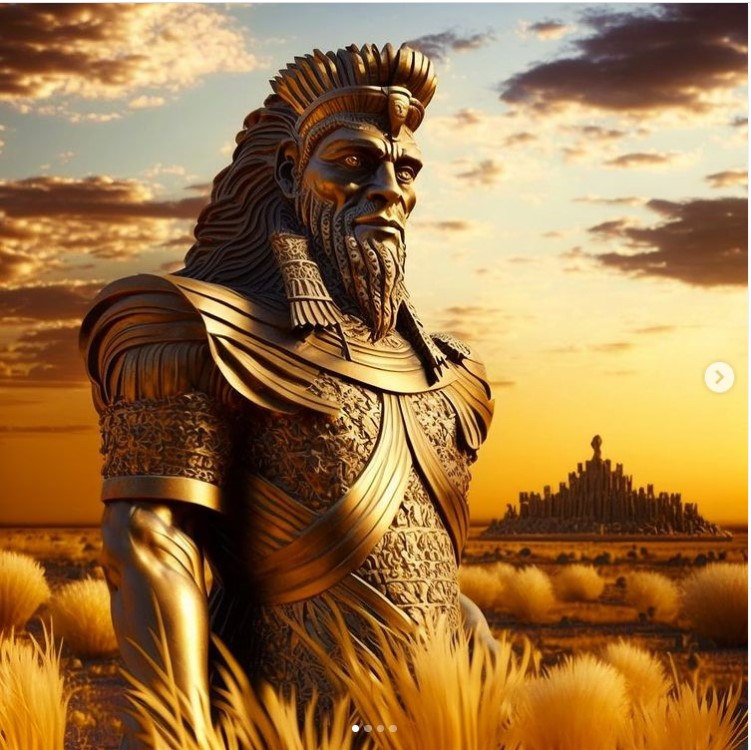
And in the second year of the reign of Nebuchadnezzar, Nebuchadnezzar dreamed dreams, wherewith his spirit was troubled, and his sleep brake from him. Then the king commanded to call the magicians, and the astrologers, and the sorcerers, and the Chaldeans, for to shew the king his dreams. So they came and stood before the king. And the king said unto them, I have dreamed a dream, and my spirit was troubled to know the dream. Then spake the Chaldeans to the king in Syriack, O king, live forever: tell thy servants the dream, and we will shew the interpretation. The king answered and said to the Chaldeans, The thing is gone from me: if ye will not make known unto me the dream, with the interpretation thereof, ye shall be cut in pieces, and your houses shall be made a dunghill. (Daniel 2:1-5 KJV)
10 Dreams that changed human history
Dream interpretation was regarded by ancient peoples in Mesopotamia, Egypt, Greece, and Rome as an art requiring intelligence and, sometimes, divine inspiration. It became a motif in literature. It was treated as a science by philosophers and physicians. Dreams were thought to come either as clear messages, or as symbols requiring interpretation. In a method called incubation, the dreamer could sleep in a sacred place in expectation of a dream that would elucidate a problem for which the dreamer desired guidance. Dream-books listing images and their meanings were popular [and are still today]. Historians reported leaders’ famous dreams that affected the course of events.1
I thought that was interesting, so I googled, “Historians reported leaders’ famous dreams that affected the course of events.” The very first search result was an article by Rebecca Turner for Discover Magazine entitled, 10 Dreams that Changed Human History.2 Here are a few of them:
- In 1816 the story of Frankenstein, often cited as the world’s first science fiction novel, was inspired by a vivid nightmare experienced by Mary Shelly.
- In 1965, Paul McCartney composed the entire melody for the hit acoustic song Yesterday in a dream.
- The father of quantum mechanics, Niels Bohr, often spoke of the inspirational dream that led to his discovery of the structure of the atom.
- Albert Einstein, as it happens, came to an extraordinary scientific achievement, the discovery of the principle of relativity, after having a vivid dream.
So, far from being just random, non-sensical deliriums, dreams have had an extraordinary impact on the world as we know it, and God is front and center in all of it. Israel would have been lost before it was found if God hadn’t given a spoiled kid a few dreams. Jacob’s ladder, Daniel’s beasts, Pharoah’s cows, the Magi’s warning, the nightmare of Pilate’s wife, the cupbearer’s grapes, the baker’s baskets, the Midianite’s loaf of barley, Joseph’s call to Egypt and return home again, along with Rebecca Turner’s 10 Dreams That Changed Human History, let’s me know that God has inserted Himself into the affairs of humanity through dreams at key points throughout history. We serve a very “hands-on” sort of God.
Maybe this has happened to you? You have a particularly vivid dream and it has you wired in the morning, either positively or not. You were in the middle of it when you woke up from what seemed like a sound sleep, and it feels as if it was the dream itself that roused you, but you can’t remember the dream. It is right there, around the edges of your subconscious mind trying to find its way out but you just can’t seem to grab it.
This is what happened to Nebuchadnezzar. So, he calls for all the wise men that serve him – the magicians, and the astrologers, and the sorcerers, and the soothsayers, and the Chaldeans and he tells them what has happened and asks them what it means. Of course, the wise men responded by asking for the king to share the dream so that they might interpret it, but he doesn’t remember.
Then the king gets nasty, threatening to cut into pieces every magician, every astrologer, every sorcerer, every soothsayer, and Chaldean unless they describe to him the dream he has forgotten and the interpretation of it. When they protest, the king said, “I know of certainty that you would gain the time, because you see the thing is gone from me.” (Daniel 2:8 KJV) He accuses them of attempting to manipulate the situation with stalling tactics. The decree goes out to cut into pieces every magician, every astrologer, every sorcerer, soothsayer, and Chaldean.
Well, Daniel petitions the king for an audience and saves the day, quite literally. He is brought before the king and tells Nebuchadnezzar that the God of the Universe has shown him the interpretation and to prove it, his God has also revealed to him the dream which the king had forgotten.
“Thou, O king, art a king of kings: for the God of heaven hath given thee a kingdom, power, and strength, and glory.” (Daniel 2:37 KJV)
Daniel describes a large image with a head made of gold, a chest and arms made of silver, its midsection and thighs were made of brass, legs made of iron, and its feet made part of iron and part of clay. Daniel goes on to say that the king also saw a stone cut without hands, hit the image on the feet that were of iron and clay, and broke them to pieces, which causes the whole image to crumble and turn into dust.
The image, Daniel tells Nebuchadnezzar, is God’s revelation of what will come to pass. The head of gold is the king’s present kingdom, Babylon, the greatest of earthly kingdoms, and each part of the image represents kingdoms of the future which didn’t exist yet at that time. The other parts of the image are made of successively more common metals indicating that none can match Babylon in its might. The feet and toes of iron and clay, struck by the stone, represent a confederation of kings in the last days that will be destroyed by the Kingdom of Christ and be turned to dust.
Nebuchadnezzar was astonished! Not only did the God of Israel reveal to His servant Daniel the interpretation, but He revealed the forgotten dream as well, proving his authenticity. Daniel pointed out to the king that the God of gods revealed to Nebuchadnezzar the future.
“The king answered unto Daniel, and said, ‘Of a truth it is, that your God is a God of gods, and a Lord of kings, and a revealer of secrets, seeing thou couldest reveal this secret.’” (Daniel 2:47 KJV)
So, Nebuchadnezzar made Daniel a great man, and gave him many great gifts, and made him ruler over the whole province of Babylon, and chief of the governors over all the wise men.
The king, sometime after these events, erects a golden statue 90 feet high out in the plain of Dura. The best estimates put the raising of the golden image in 585 BC, 19 years after his dream had been interpreted by Daniel. I can’t help but think that the dream was behind it, but not to garner worship for himself. He erected the statue to honor the God of all gods and a Lord of all kings, the revealer of secrets – the God of Daniel who gave him a dream about an image much like this one.3 Nebuchadnezzar then issues a decree that, at the sound of the music, everyone must bow to this idol or risk being cast into the fiery furnace.
Misguided as it was, I think the king was searching for a way to worship the God of Daniel, after all, God reached out to him directly through the dream and indirectly through His prophet with the interpretation. Then, nearly 20 years since His encounter with God, he is trying to recreate something like it again. This is just me. So, why do I say this? Because we do the same thing all the time.
How many of us, after encountering God through our baptism and infilling of the Holy Spirit, sought to recreate an experience through the work of our own hands. Who among us has not experienced the elation and excitement that comes with a powerful manifestation of God’s Spirit in a church service only to thirst for more as time passes. We then find ourselves attempting to manufacture the experience to relive it all over again. Are we not worshiping the creation more than the creator?
It has been my experience that Pentecostals are prone to coming to church services with a certain expectation about the moving of the Holy Ghost. We remember the glories of times past and long for them again. I’ve heard it referred to as, “putting God in a box”. We then set out to manufacture those glories and we’re all complicit in it, from the platform to the back of the sanctuary.
Come on, I don’t want to lose you here! We know what types of songs elicit what types of reactions from the congregation and that those songs are arranged in an order most conducive to getting those reactions. The refrain is repeated over and over again, like sparks from a flint being struck repeatedly until the kindling catches fire. Behavior that can be best described as “cheerleading” is prevalent from the very first time a microphone is picked up all the way to the end of the service. Evangelists, having perfected the use of homiletics, know when to change the tone and volume of their preaching and which phrases, words and even syllables to emphasize on their way, if successful, to inciting what looks like mass hysteria to an outsider. Then we wear it all as a badge of honor, proclaiming we never know what God is going to do in our services.
In the sanctuary, young Christians and seasoned saints alike search for the right combination of running, jumping, dancing, clapping, and singing that will ignite the feelings that we desire. “If I raise and shake my hands just so, say hallelujah, and speak in tongues, maybe the atmosphere can be filled with the Holy Ghost the way it was in the past and I can get a refilling.”
While genuine worship is there, we are also worshiping a 90-foot golden image out in the plain of Dura trying to get back to a feeling first experienced in a dream-like encounter. This is not something new. It has been going on for 100 years or more, maybe for as long as the fresh fire experience, or the latter rain, has been with us. It was certainly a part of our services when I found the way, more than 40 years ago. I remember wanting to run the isles at church and waiting for God to “come upon me” to do so. Someone said that I needed to step out (literally) in faith, so I did. That just resulted in “me” running around in church. It sure sounds like pursuing the blessing instead of the blesser.
My purpose, here, is not to impugn genuine moves of God on an emotional plane as these have been manifest in extraordinary ways that so many of us have experienced. However, these are incredibly rare and what passes for it most of the time is a delusional response to our misplaced longing. We should take down that golden image and come home from the plain of Dura. It is time. Let’s forget about chasing a feeling and, instead, pursue Christ. Let’s trust and worship Him every time we gather in the House of God. Let’s take God out of the box of our preconceived ideas and let Him do what He wants to do. One thing I do know is that He wants us to really notice who is in the service with us. I have a feeling that there are many that are hurting and what they need cannot be found in Dura.
Endnotes
1Hughes, J.D. Dream Interpretation in Ancient Civilizations. Dreaming 10, 7–18 (2000). https://doi.org/10.1023/A:1009447606158
2Turner, Rebecca in Discover Magazine, 10 Dreams that Changed Human History. https://www.world-of-lucid-dreaming.com/10-dreams-that-changed-the-course-of-human-history.html (Accessed 9/15/2023)
3Despite the similarity of the image in Dura to the image in Nebuchadnezzar’s dream, despite the king’s adulation for the High God, and despite his propensity to command honor for the God of Daniel and of Shadrach, Meshach, and Abednego, (Daniel 3:29; 4:1-3, 37), virtually all of the commentaries on this subject that I have read (Matthew Henry, Ellicott, Barnes, Benson, Jamieson-Fausset-Brown, Gills, and the Pulpit Commentary) fail to relate the erecting of Nebuchadnezzar’s image to the paying of homage to the God of the Hebrews, but do not prove otherwise either. I am not a theologian, but I think it is safe to say that the image in Dura was spawned in the mind of the king, at least in part, by the dreams.
 Sketches on the way